

Have you ever wondered how long 1 meter actually is? Whether you are measuring furniture, planning a home improvement project, or comparing everyday objects, understanding this measurement can be very useful. One meter is a common unit of length used in homes, schools, construction, and many other areas of daily life.
1 meter is equal to 100 centimeters, 39.37 inches, or approximately 3.28 feet. This means it is slightly longer than a standard 3-foot measurement.
You can find many everyday objects that measure approximately 1 meter long. Some examples include a meter stick, a standard guitar, a baseball bat, a small dining table, and a kitchen countertop section. These familiar objects can help you understand the actual size of one meter without using a measuring tape.
In this article, we will explain how long 1 meter is, explore 12 common things that are approximately 1 meter long, and provide easy comparisons to help you visualize this measurement.
How Long Is 1 Meter?
1 meter is exactly 100 centimeters or 1,000 millimeters. When converted into other commonly used measurement units, it equals approximately 39.37 inches, 3.28 feet, or 1.09 yards.
In simple terms, one meter is a little longer than three feet. If you have a standard meter stick, you already have an accurate example of this measurement.
Another way to visualize one meter is to imagine placing two 50-centimeter rulers end to end. Together, they create a total length of exactly 100 centimeters, which equals one meter.
One meter is commonly used to measure furniture, room dimensions, sports equipment, fabrics, and household accessories. It is a convenient measurement because it is neither extremely short nor particularly long.
Here are some useful conversions:
- 1 meter in centimeters: 100 cm
- 1 meter in inches: 39.37 inches
- 1 meter in feet: 3.28 feet
- 1 meter in millimeters: 1,000 mm
- 1 meter in yards: 1.09 yards
- 1 meter in kilometers: 0.001 km
For a simple comparison, imagine a standard full-size guitar. Many acoustic guitars measure close to one meter from the top of the headstock to the bottom of the body.
Understanding this length becomes easier when you compare it with objects you regularly see at home, school, or work.
Quick Comparison of 1 Meter Examples
The following table shows 12 everyday objects that can measure approximately one meter. Their actual dimensions may vary depending on the brand, model, and design.
| Common Object | Approximate Length | Comparison |
|---|---|---|
| Meter Stick | 100 cm | Exact measurement |
| Full-Size Acoustic Guitar | 100–105 cm | Close to 1 meter |
| Long Baseball Bat | 90–100 cm | Almost 1 meter |
| Small Dining Table | 100 cm | Common compact length |
| Kitchen Countertop Section | 100 cm | Standard-sized section |
| Large Walking Stick | 95–105 cm | Around 1 meter |
| Standard Broom | 100–120 cm | Some models are close |
| Compact Bookshelf | 100 cm | Common shelf height |
| Large Wall Mirror | 100 cm | Common mirror length |
| Small Garden Shovel | 95–105 cm | Approximately 1 meter |
| Medium Folding Table | 100 cm | Compact table length |
| Long Curtain Rod | 100 cm | Common short rod length |
These objects provide practical references for understanding one meter. Some are manufactured to measure exactly 100 centimeters, while others may be slightly shorter or longer.
Related Post:14 Common Things That Are 4 Feet Long:
12 Common Things That Are 1 Meter Long
One meter is a measurement that appears in many everyday objects. From household furniture to sports equipment and gardening tools, you can find several items that measure approximately 100 centimeters.
Below are 12 familiar examples that will help you understand what one meter looks like in real life.
1. Meter Stick
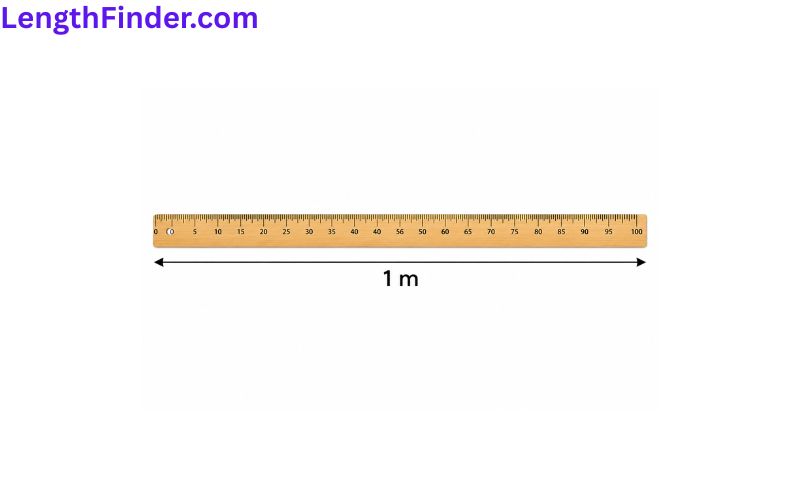
A meter stick is one of the most accurate examples of something that measures exactly one meter long. It is a measuring tool commonly used in classrooms, workshops, laboratories, and construction projects.
Unlike a standard school ruler, which is usually 30 centimeters long, a meter stick provides a full 100-centimeter measuring scale. This makes it useful for measuring larger objects, such as desks, furniture, doors, and classroom equipment.
Meter sticks are commonly made from wood, plastic, or metal. They usually feature centimeter and millimeter markings that allow users to measure objects accurately.
For example, if you place a meter stick horizontally on a table, the distance between its 0 cm and 100 cm marks represents exactly one meter.
It is also helpful for understanding smaller measurements. Half a meter equals 50 centimeters, while one-quarter of a meter equals 25 centimeters.
If you want to visualize one meter accurately, a meter stick is the simplest and most reliable reference.
2. Full-Size Acoustic Guitar
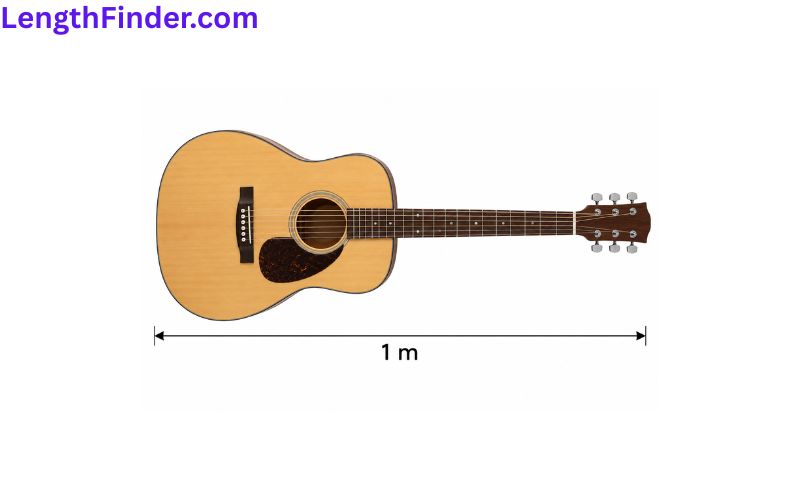
A full-size acoustic guitar is another familiar object that measures approximately one meter long. Many standard acoustic guitars have an overall length ranging from about 100 to 105 centimeters, depending on their design and manufacturer.
The total length includes the guitar’s headstock, neck, and body. This makes a guitar an excellent reference for understanding the size of one meter.
Acoustic guitars are widely used for music practice, live performances, recording, and entertainment. They come in several body shapes and sizes, including dreadnought, concert, and auditorium designs.
Although the body dimensions may differ, many full-size models have an overall length close to 100 centimeters.
For example, if you place a standard acoustic guitar on the floor and measure it from the top of the headstock to the bottom of the body, you may find that it is slightly longer than one meter.
This makes a full-size acoustic guitar a useful visual comparison for estimating the length of one meter.
3. Long Baseball Bat

A long baseball bat is another sports item that can help you visualize approximately one meter. Baseball bats are used in baseball games and training sessions to hit balls thrown by a pitcher.
Adult baseball bats are available in different lengths, with many measuring between approximately 81 and 86 centimeters. However, some longer bats and specialized training models can approach 90 to 100 centimeters.
A bat measuring close to one meter is noticeably longer than many standard playing bats.
Baseball bats are commonly manufactured from wood, aluminum, or composite materials. Their length and weight are important because they affect how comfortably a player can swing the bat.
When comparing a baseball bat with one meter, remember that not every bat reaches this measurement.
For example, a 90-centimeter bat is 10 centimeters shorter than one meter.
Nevertheless, a particularly long baseball bat or training bat can provide a useful approximate reference for understanding this length.
4. Small Dining Table

A small dining table is another household item that can measure approximately one meter along its longer side. Compact dining tables are commonly used in apartments, small kitchens, studio homes, and dining corners.
Many rectangular dining tables designed for two people have lengths close to 100 centimeters. This size provides enough space for plates, glasses, and small serving dishes without occupying too much floor space.
These tables are available in different materials, including wood, metal, glass, and engineered wood.
A dining table measuring one meter long can be a practical choice for people who want a comfortable eating area in a limited space.
For example, if you have a rectangular dining table that measures 100 centimeters from one end to the other, that distance is exactly one meter.
You can use this comparison when planning furniture arrangements or estimating the available space in a room.
5. Kitchen Countertop Section

A kitchen countertop section can also measure approximately one meter long. Kitchen countertops provide working surfaces for preparing food, arranging appliances, and completing everyday cooking tasks.
Although full kitchen countertops are usually much longer, individual sections may measure around 100 centimeters.
For example, a compact countertop installed between a refrigerator and a kitchen cabinet might have a length of one meter.
Countertops are manufactured using materials such as granite, marble, quartz, laminate, and stainless steel. Their dimensions depend on the kitchen layout and available space.
A one-meter countertop section can provide enough room for a small coffee machine, cutting board, and other kitchen accessories.
When measuring a countertop, the length refers to the horizontal distance from one end to the other.
If you have a kitchen counter with a 100-centimeter section, it offers a convenient everyday example of how long one meter is.
Related Post:15 Common Things That Are 24 Inches Long
6. Large Walking Stick

A large walking stick is another object that can measure approximately one meter long. Walking sticks are commonly used for additional support while walking, hiking, or traveling across uneven ground.
Many traditional walking sticks and canes have lengths ranging from approximately 85 to 105 centimeters, depending on the user’s height and the intended purpose.
A walking stick measuring 100 centimeters is exactly one meter long.
These sticks can be made from wood, aluminum, carbon fiber, or other durable materials. Some feature curved handles, rubber tips, or adjustable sections for added comfort.
Walking sticks are also used during outdoor activities, particularly when walking on hills or rough surfaces.
However, the correct walking stick length depends on the individual. A stick that is too long or too short may be uncomfortable to use.
For visual comparison, imagine a straight walking stick standing vertically beside a wall. If its length is 100 centimeters, it represents one meter from the floor to its upper end.
7. Standard Broom
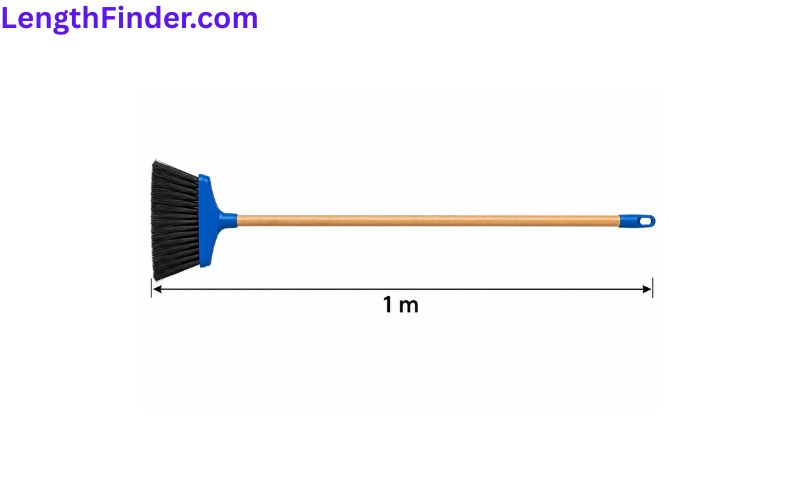
A household broom is another familiar cleaning tool that can measure around one meter long. Brooms are commonly used to remove dust, dirt, and small debris from floors, patios, and outdoor areas.
Many household brooms have total lengths ranging from approximately 100 to 120 centimeters, although compact models may be shorter.
A broom measuring 100 centimeters from the top of its handle to the bottom of its bristles is exactly one meter long.
Brooms are available in different designs, including soft indoor brooms, stiff outdoor brooms, and traditional straw brooms.
The handle is usually made from wood, plastic, or metal, while the cleaning head contains synthetic or natural bristles.
Because brooms are found in most homes, they provide a convenient way to estimate this measurement.
However, not all brooms are one meter long. If you want an accurate comparison, measure the entire broom before using it as a reference.
8. Compact Bookshelf

A compact bookshelf is another piece of furniture that may measure approximately one meter in height. Bookshelves are commonly used in bedrooms, living rooms, offices, and study areas to organize books and decorative items.
Many small freestanding bookshelves are manufactured with heights close to 100 centimeters.
This size is convenient because it provides several storage levels without requiring a large amount of wall space.
Compact bookshelves are available in wood, metal, plastic, and engineered wood. Some feature open shelves, while others include doors or drawers.
A bookshelf measuring 100 centimeters tall reaches exactly one meter from its base to its top surface.
For example, if you place a meter stick vertically beside a one-meter bookshelf, both will reach the same height.
This makes a compact bookshelf a useful reference when estimating vertical measurements, especially when arranging furniture or planning storage spaces.
9. Large Wall Mirror
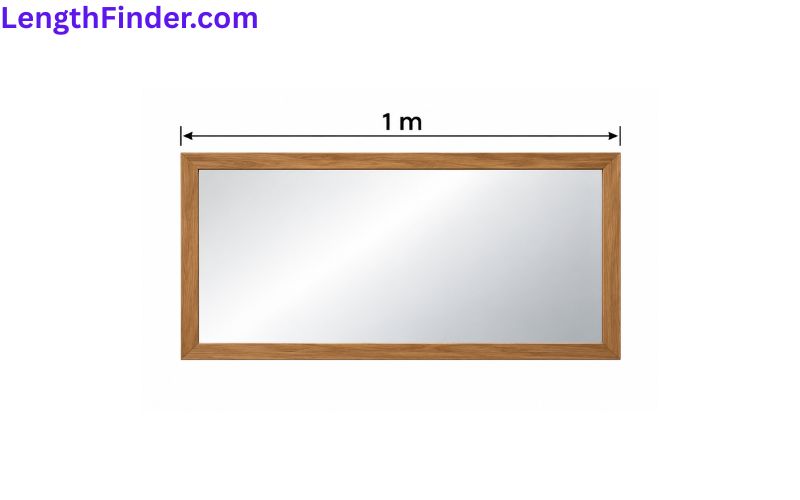
A large wall mirror is another household accessory that can measure approximately one meter long. Wall mirrors are commonly installed in bedrooms, bathrooms, dressing areas, hallways, and living rooms.
Many rectangular wall mirrors are available in dimensions such as 100 × 50 centimeters or 100 × 60 centimeters.
In these examples, the longer side measures exactly one meter.
Wall mirrors are available in different styles, including frameless, wooden-framed, metal-framed, and decorative designs.
A mirror measuring one meter in height can provide a useful reflection of the upper body or a larger portion of a person’s appearance, depending on its placement and viewing distance.
It can also make a room appear brighter by reflecting natural and artificial light.
If you have a rectangular wall mirror at home, measure its longer edge. You may find that it is close to 100 centimeters, making it a practical reference for understanding one meter.
Related Post:14 Common Things That Are 1 Centimeter?
10. Small Garden Shovel

A small garden shovel is another tool that may measure approximately one meter from the top of its handle to the tip of its blade.
Garden shovels are commonly used for digging soil, planting flowers, moving compost, and completing landscaping tasks.
Some compact, long-handled garden shovels have overall lengths ranging from approximately 95 to 105 centimeters.
A shovel measuring 100 centimeters provides a clear example of one meter.
These tools are usually manufactured with wooden, fiberglass, or metal handles and durable steel blades.
The handle length is important because it affects how comfortably a person can use the shovel while standing or bending.
Shorter shovels are often preferred for working in smaller gardens, while longer tools may be more suitable for larger outdoor projects.
When comparing a shovel with one meter, remember to measure its complete length, including both the handle and blade.
11. Medium Folding Table

A medium folding table is another everyday object that can measure approximately one meter long. Folding tables are commonly used in homes, offices, classrooms, outdoor events, and temporary workspaces.
Many compact rectangular folding tables have lengths close to 100 centimeters, although larger models can be considerably longer.
A one-meter folding table provides a convenient surface for studying, using a laptop, serving refreshments, or arranging household items.
These tables are often manufactured using plastic, wood, or lightweight metal frames. Their foldable design makes them easy to store when they are not being used.
For example, a folding table measuring 100 centimeters from its left edge to its right edge has a length of exactly one meter.
This comparison is particularly useful when purchasing furniture online because product dimensions are usually listed in centimeters.
Understanding one meter can help you determine whether a folding table will fit comfortably into your available space.
Related Post:10 Common things that are 20 inches long?
12. Long Curtain Rod

A short curtain rod is another common household accessory that can measure approximately one meter long. Curtain rods are installed above windows to support curtains, drapes, and decorative window coverings.
Many adjustable curtain rods are available in different lengths, including models that can be set to approximately 100 centimeters.
A curtain rod adjusted to 100 centimeters represents exactly one meter.
These rods are commonly made from metal, wood, or plastic. Some include decorative ends, while others feature simple designs intended for modern interiors.
Curtain rods are often adjustable so they can fit windows of different widths.
For example, a small window may require a curtain rod measuring approximately one meter, depending on the width of the window and the desired curtain coverage.
If you have an adjustable curtain rod at home, extending it to 100 centimeters provides an easy way to visualize this measurement.
How to Measure 1 Meter Without a Measuring Tape
Measuring one meter without a measuring tape is possible when you use familiar objects with known dimensions. Although these methods may not always provide perfect accuracy, they can be useful for quick estimates.
One of the easiest methods is to use a standard 30-centimeter school ruler. Measure three full ruler lengths to reach 90 centimeters, then add another 10 centimeters. Together, these measurements equal exactly one meter.
You can also use two 50-centimeter rulers placed end to end.
Another convenient method is to use a meter stick, which is specifically designed to measure 100 centimeters.
If you do not have measuring tools, you can compare the distance with a full-size acoustic guitar, compact bookshelf, or another object that you know measures approximately one meter.
However, remember that everyday objects vary in size.
For accurate measurements, particularly when buying furniture, installing shelves, or completing construction work, a proper measuring tape is always recommended.
Related Post:12 Common Things That Are 18 Feet Long?
How Big Is 1 Meter Compared to a Human Body?
Comparing one meter with the human body can make this measurement easier to understand. However, body dimensions vary depending on age, height, and individual proportions.
For example, one meter is approximately the height of a young child, although children of the same age can have different heights.
For an adult who is 170 centimeters tall, one meter represents about 59% of their total height.
You can also compare one meter with an adult’s arm length or the distance between different body landmarks. However, these measurements are not standardized and should only be used for rough estimates.
Another useful comparison is the height of a person’s waist or hip area from the floor. For some adults, this distance may be close to one meter, while for others it may be noticeably different.
These comparisons help you visualize one meter without using a ruler.
For greater accuracy, use a meter stick or measuring tape rather than relying on body measurements.
Is 1 Meter the Same as 3 Feet?
One meter is close to three feet, but the two measurements are not exactly equal.
1 meter equals approximately 3.28 feet, while 3 feet equals exactly 91.44 centimeters.
This means one meter is 8.56 centimeters longer than three feet.
In inches, one meter measures approximately 39.37 inches, while three feet equals 36 inches.
The difference is approximately 3.37 inches.
For everyday estimates, people sometimes describe one meter as slightly more than three feet. This is a useful comparison when discussing furniture dimensions, room measurements, and household objects.
However, when working on projects that require precision, such as carpentry, construction, or technical drawing, it is important to use the correct conversion.
For example, if a table must fit into a space measuring exactly three feet, a table that is one meter long will be too large.
Therefore, although one meter and three feet are similar, they should not be treated as identical measurements.
Where Is the 1 Meter Measurement Commonly Used?
The meter is one of the most widely used units of length in the metric system. It is commonly used in education, construction, sports, furniture manufacturing, and everyday household activities.
In schools, students learn about meters when studying measurement, geometry, and mathematics. Meter sticks and measuring tapes help them understand distances and dimensions.
In construction, meters are used to measure walls, doors, rooms, and building materials. Accurate measurements are important for planning and completing projects.
Furniture manufacturers also use meters and centimeters to describe the dimensions of tables, cabinets, bookshelves, and other household products.
In sports, meters are used to measure running distances, swimming pool lengths, and the dimensions of playing areas.
The measurement is also useful when purchasing curtains, carpets, fabrics, and home accessories.
Understanding one meter makes it easier to compare product sizes, estimate distances, and complete everyday measuring tasks.
Related Post:11 Common Things That Are 30 Centimeters Long
Frequently Asked Questions (FAQs)
1. How long is 1 meter in feet?
One meter equals approximately 3.28 feet. This means it is slightly longer than three feet.
To convert meters into feet, multiply the measurement in meters by 3.28084.
For example:
1 × 3.28084 = 3.28084 feet
This conversion is useful when comparing measurements expressed in the metric system with those expressed in feet.
For example, a table measuring one meter long is approximately 3 feet and 3.37 inches long.
Understanding this conversion can help when shopping for furniture, measuring household spaces, or comparing product dimensions.
2. How many inches are in 1 meter?
One meter equals approximately 39.37 inches. Since one inch is exactly 2.54 centimeters, you can convert meters into inches by first converting the measurement into centimeters.
One meter contains 100 centimeters.
Therefore:
100 ÷ 2.54 = 39.37 inches
This means one meter is slightly longer than 39 inches.
For comparison, three feet equals 36 inches, so one meter is approximately 3.37 inches longer than three feet.
This conversion is useful when comparing metric measurements with product dimensions listed in inches, especially for furniture, tools, and household accessories.
3. What common objects are 1 meter long?
Several everyday objects can measure approximately one meter long. Examples include a meter stick, full-size acoustic guitar, small dining table, walking stick, compact folding table, and adjustable curtain rod.
Other objects, such as large wall mirrors, compact bookshelves, garden shovels, and some household brooms, may also have dimensions close to 100 centimeters.
However, their exact measurements depend on the manufacturer and design.
For example, a standard meter stick measures exactly one meter along its scale, while a full-size acoustic guitar may be slightly longer.
These objects provide useful references when you need to estimate one meter without a measuring tape.
4. Is 1 meter longer than 1 yard?
Yes, one meter is slightly longer than one yard.
One yard equals exactly 91.44 centimeters, while one meter equals 100 centimeters.
Therefore, one meter is 8.56 centimeters longer than one yard.
When converted into yards, one meter equals approximately 1.09 yards.
This difference is useful to understand when measuring fabrics, sports fields, carpets, and other materials.
For example, if you purchase one meter of fabric, you receive slightly more material than if you purchase one yard.
Although the two measurements are relatively close, they are not interchangeable when precise dimensions are required.
5. How can I visualize 1 meter without a ruler?
You can visualize one meter by comparing it with familiar household objects that measure approximately 100 centimeters.
A full-size acoustic guitar is one useful example because many models have an overall length close to one meter.
You can also imagine a compact bookshelf measuring 100 centimeters tall or a small dining table measuring one meter along its longer side.
Another method is to use a standard 30 cm school ruler three times and add another 10 centimeters.
If you have two 50 cm rulers, placing them end to end creates exactly one meter.
These methods are useful for quick estimates, but a measuring tape is recommended when accuracy is important.
6. Is 1 meter considered a long distance?
One meter is generally considered a relatively short distance when compared with the dimensions of rooms, buildings, roads, or outdoor spaces.
However, it can be a considerable length when compared with smaller household objects.
For example, one meter is much longer than a standard pencil, smartphone, or school notebook.
On the other hand, it is shorter than the length of most beds and many dining tables.
In everyday life, one meter is a practical measurement for furniture, tools, and household accessories.
Whether it seems long or short depends on the object or distance being measured.
7. How many centimeters make 1 meter?
There are exactly 100 centimeters in one meter.
The relationship between meters and centimeters is an important part of the metric system.
To convert meters into centimeters, multiply the number of meters by 100.
For example, 2 meters equals 200 centimeters, while 0.5 meters equals 50 centimeters.
Similarly, 1.5 meters equals 150 centimeters.
This conversion is commonly used when measuring furniture, clothing materials, room dimensions, and everyday household objects.
Understanding that one meter equals 100 centimeters makes it easier to switch between larger and smaller metric measurements.
Conclusion
Understanding how long 1 meter is becomes much easier when you compare it with familiar everyday objects.
One meter equals exactly 100 centimeters or 1,000 millimeters, which is approximately 39.37 inches or 3.28 feet.
Common examples of objects that can measure around one meter include a meter stick, full-size acoustic guitar, small dining table, walking stick, compact bookshelf, large wall mirror, and adjustable curtain rod.
Although the exact dimensions of these objects may vary, they provide useful references for estimating this length.
The next time you need to visualize one meter, remember that it is slightly longer than three feet and approximately the same length as a standard meter stick or full-size acoustic guitar.